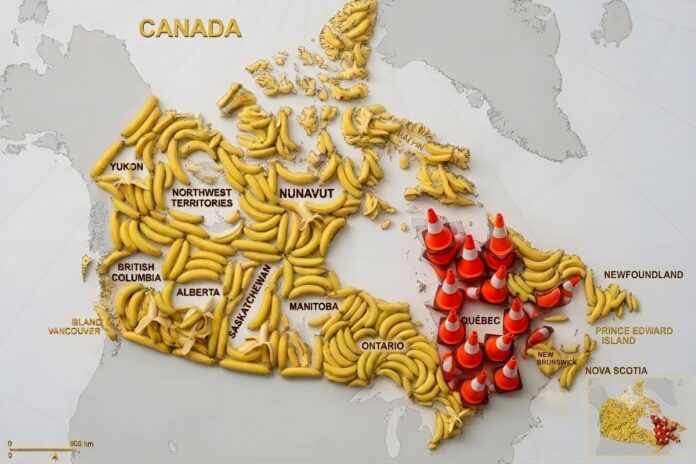
From Maple Leaf to Banana Republic: How Canada Lost Its Way
Canada, The Banana Republic: Now Featuring 100% Corruption and how Canada Gained Its Banana Republic Badge
Canada has long been associated with maple syrup, courteous public discourse, and a northern climate. In recent decades, however, structural features of its political economy have drawn comparisons to the classic “banana republic” model an economy characterized by concentrated corporate power, heavy reliance on a narrow set of resource or speculative activities, limited competitive discipline, and elite enrichment facilitated by institutional arrangements that prioritize continuity over rigorous public accountability. Unlike traditional examples built on tropical monocultures and military intervention, Canada has developed a colder-climate variant sustained by oligopolistic markets, housing-driven capital allocation, resource extraction, and regulatory practices that often align closely with incumbent interests.
Oligopolies Presented as Competitive Markets
In telecommunications, a small number of national carriers primarily Bell, Rogers, and Telus have long dominated mobile wireless services. Official price-comparison studies conducted for the Government of Canada have repeatedly placed Canadian mobile wireless prices among the highest in a set of peer industrial jurisdictions. In the 2024 international benchmarking exercise, Canada ranked among the top three highest-priced markets across multiple service baskets, with prices frequently exceeding those in the United Kingdom, France, Germany, and Italy by substantial margins, particularly on a per-gigabyte basis for mid- and high-usage plans. Ised-isde.canada
This outcome is consistent with limited effective competition. The three largest operators account for the overwhelming majority of mobile and internet revenues and subscribers. Regulatory efforts to expand wholesale access and encourage new entrants have produced incremental changes, yet structural concentration has persisted, sustaining elevated average revenue per user relative to many peer countries.
A parallel pattern appears in food retail. Loblaw Companies, Empire Company (Sobeys), and Metro, together with large general merchandisers such as Costco and Walmart, control the greater part of national grocery sales. Estimates of the combined share of the three traditional national grocers commonly exceed 60 percent in core supermarket channels, with broader measures of the top five retailers reaching 70 percent or higher in recent industry analyses. High concentration limits the intensity of price competition and reduces the scope for independent retailers to discipline pricing or assortment decisions. Canadians therefore confront elevated food prices in an environment where true price discovery is constrained. Grocerytradenews
The domestic banking sector exhibits similar characteristics. The five or six largest banks control approximately 90 to 95 percent of banking-system assets. Barriers to entry for foreign institutions remain significant, particularly for retail deposit-taking. Non-interest fee income constitutes a material share of earnings; comparative analyses have estimated that Canadian households pay several billion dollars more annually in fees than counterparts in more competitive jurisdictions such as the United Kingdom. Stability has been a genuine public benefit—Canadian banks navigated the 2008 global financial crisis relatively well—yet the same concentration has muted competitive pressure on fees and product innovation. Corporateknights
An Economy Anchored in Housing and Resource Extraction
Rather than broad-based technical or manufacturing innovation, a large share of Canadian capital formation has been directed toward residential real estate. OECD data indicate that Canada recorded the highest average residential investment as a percentage of GDP among member countries over the 2018–2023 period, at approximately 8.3 percent, nearly double the United States figure of 4.2 percent. Housing has accounted for roughly one-third of total investment in certain multi-year windows, well above the share observed in most G7 peers. This pattern elevates household leverage, crowds out machinery, equipment, and research-and-development spending, and converts domestic shelter into a primary vehicle of wealth accumulation and intergenerational transfer. TheHub
Complementing housing is a sustained dependence on primary resource extraction and related exports. Energy products, minerals, metals, and forest products continue to represent a large fraction of merchandise exports frequently approaching or exceeding half of the total in recent years while downstream, higher-value manufacturing and advanced processing remain comparatively underdeveloped relative to the resource base. Natural-resources activity, measured directly and indirectly, contributes a material share of national GDP and employment, particularly in specific provinces. This structure echoes the classic banana-republic reliance on a narrow set of exportable commodities, with limited domestic value-added transformation. Yes Canada, The Banana Republic: Now Featuring 100% Corruption.
Regulatory Capture and Institutional Inertia

Where traditional banana republics relied on overt political or military control, the Canadian variant operates through quieter mechanisms of regulatory capture and soft accountability. Personnel movement between regulated industries and the agencies charged with overseeing them—the “revolving door”—is well documented across jurisdictions and has been observed in Canadian telecommunications, financial services, and other sectors. Criticisms of the Canadian Radio-television and Telecommunications Commission, for example, have periodically centered on decisions perceived as overly accommodating to incumbent carriers.
Ethics enforcement has similarly tended toward formality rather than decisive consequence. High-profile cases, including the SNC-Lavalin affair (in which the Conflict of Interest and Ethics Commissioner found that the Prime Minister and his office had improperly sought to influence a prosecution decision) and the WE Charity contract controversy (which produced findings of preferential treatment and conflict-of-interest violations against a senior minister), illustrate a pattern in which formal findings are issued, public apologies are offered, and institutional continuity is largely preserved. Penalties with material deterrent effect remain limited. This “polite” style of accountability sustains public trust in process while leaving underlying incentive structures largely intact.
Data Snapshot and Analytical Perspective
- Canadian mobile wireless prices have ranked among the highest in peer comparisons for multiple service levels and per-gigabyte metrics in successive government-commissioned studies.
- Residential investment has occupied a disproportionately large share of Canadian capital formation relative to other advanced economies.
- Market concentration in grocery retail and domestic banking remains elevated by international standards.
- Resource-related exports continue to dominate the merchandise trade balance.
Economists associated with institutions such as the Fraser Institute and independent consultancies have repeatedly linked these patterns to subdued productivity growth, elevated cost of living, and diminished competitive intensity. Official bodies including the Competition Bureau have examined grocery and telecom markets and recommended measures to strengthen rivalry, yet structural change has been gradual.
Canada has not descended into lawlessness or overt authoritarianism. It has instead refined a northern adaptation of the banana-republic model: corporate concentration is framed as national competence, resource and housing wealth is celebrated as comparative advantage, and institutional shortcomings are managed through procedural apology rather than systemic correction. The result is a political economy in which citizens bear elevated costs in essential markets, productive investment outside housing and extraction is constrained, and elite interests are advanced under the banner of stability and politeness. Whether this configuration is sustainable depends on the willingness of policymakers to prioritize genuine competitive discipline and diversified capital allocation over the preservation of incumbent arrangements.