
Water restrictions but $2.8 billion in military support for Ukraine
Canada is estimated to be home to 20% of the world’s freshwater. One wonders why First Nations seem to have so much, many problems with getting clean freshwater for their use. With some communities it is obvious as they were located in areas geared to get them to leave and become assimulated.
No Water but $2.8 billion military aid for Ukraine
But our communities have always been a low priority for the Federal and Provincial governments. I remember back in the early 70’s getting water for my grandfather’s house in Mistissini. At that time there was no running water or electricity or even a road into the community. I would take two 5 gallon pails and a yoke to the lake and walk uphill back to empty them into a container and do it again until it was filled. A yoke fits across the shoulder with ropes attached to hooks to hold the pails. It was necessary as each 5 gallon pail when filled weighed around 42 lbs (19 Kg) making over 80 lbs per trip.
Later when we did get running water it was taps that ran continuously placed at different points in the town. A little easier as we used a wagon to pull the filled pails along dirt roads. I often had younger members of our extended family helping me as I pulled and they pushed. Remember this was in the 1970’s and the rest of Canadians living in towns or cities never even thought about what running water in their household meant to their lives.
But First Nations did because even when they got running water it was far from safe. Back in 2015 le beau Justin Trudeau on the campaign trail promised First Nations that Liberals would eliminate all long-term drinking water advisories by the end of March 2021. The reason was 160 First Nations had long-term drinking advisories. By 2021 it had dropped to 60 but half of those had problems reaching back for over 10 years, with some over 20 years.
Without water, Ukraine received $2.8 billion in military assistance
On the western coast of James Bay I visited a First Nations community that had bad water since the 80’s. The children had lesions and sore on their faces and bodies from taking baths or showers. A place so poor the kids were lining up for BBQ baked potatoes to eat. At Moose Factory south of there water problems have people ordering water in by railroad. You see a case of water costing around $3 in the south of Canada costs about $40.
Promises are made to address this problem but Canada is not giving a timetable. A new bill promises $4.6 billion more to deal with giving First Nations clean drinking water. Many say that Bill C-37 lacks the power of a past bill and is disappointing. Even more disappointing is that water is considered a human right by the United Nations.
Some of the key principles of the human right to water say that : water must be sufficient and continuous to meet personal and domestic needs, including drinking, cooking, hygiene, and sanitation and that water sources must be physically reachable and safe for all, including vulnerable groups such as children, women, the elderly, and people with disabilities.
Also that water services must be affordable; no one should be denied access due to inability to pay and this brings the $40 a case for water into question. In looking at the First Nations issues with water the UN says water must be free from harmful microorganisms, chemicals, and radiological hazards. And as for First Nations the UN Declaration says all people, including marginalized groups, must have equal access to water and sanitation services. A clear statement that ignores First Nations issues with water.
While water is legally and ethically recognized as a human right, and states are obligated to guarantee access to safe, sufficient, and affordable water for everyone this is not happening in Canada. Some critics of Canada’s new Bill C-37 say the $4.6 billion committed is a start the real bill to solve these problems would be closer to $44 billion.
Canada’s Ukraine aid tops $26.7 billion with another $925 million gift
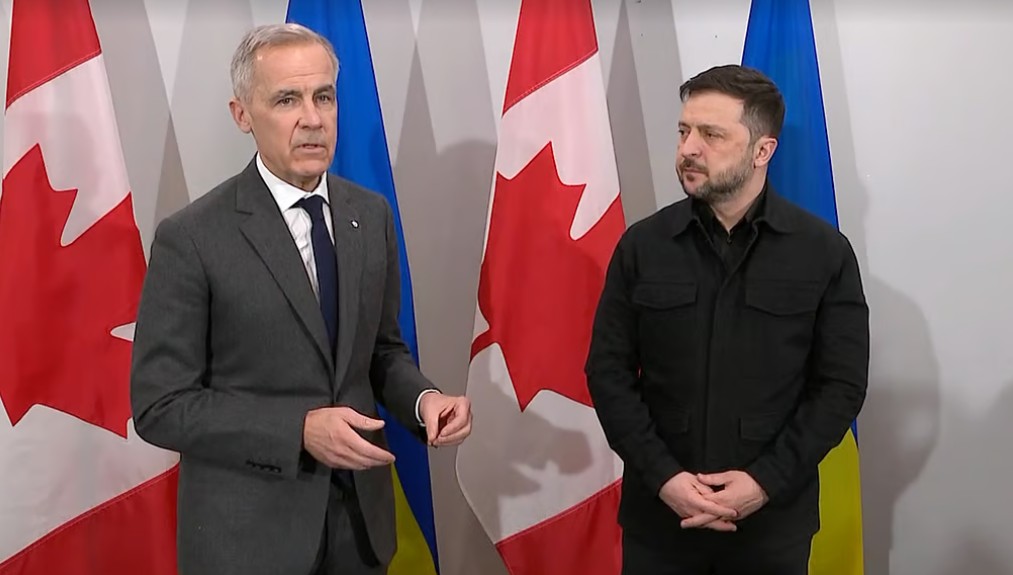
Canada’s total commitment to Ukraine has surpassed $26.7 billion after Prime Minister Mark Carney announced an additional $925 million in military assistance during a meeting with Ukrainian President Volodymyr Zelenskyy on the sidelines of the NATO summit in Ankara on Tuesday.
The new package includes $475 million for ammunition, nearly $400 million to build 35 Canadian-made armoured vehicles and $50 million for critical technology and engineering equipment.
The latest announcement raises Canada’s total pledged support for Ukraine since Russia’s full-scale invasion to more than $26.7 billion, based on previously announced federal commitments.
“Prime Minister Carney reaffirmed Canada’s unwavering support for Ukraine as it continues to defend its sovereignty and pursue a just and lasting peace,” the Prime Minister’s Office said in a statement.
The announcement forms part of Canada’s previously pledged $2.8 billion in military assistance for Ukraine this year.
Carney also confirmed Canada is extending Operation UNIFIER, the Canadian Armed Forces training mission for Ukrainian troops, until 2029.
The two leaders discussed ….
Stay tuned for my next article, where we plan to learn how the methodology is applied to allocate Canadian funds to support Ukraine.