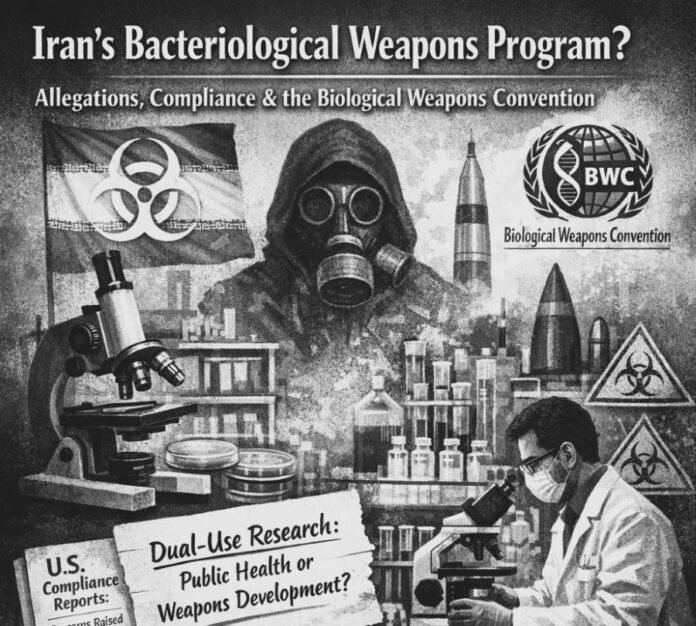
Iran’s Bacteriological Weapons Program? An Inquiry into Allegations, Compliance, and the Biological Weapons Convention
Abstract: On Microbes, Mistrust, and Multilateralism
This article examines persistent allegations regarding an Iranian bacteriological weapons program within the framework of the Biological Weapons Convention (BWC). While adopting an academic-parody tone (because if one cannot laugh softly at geopolitics, one might scream), it retains strict fidelity to verified public sources. The analysis explores Iran’s treaty commitments, U.S. compliance assessments, dual-use biotechnology concerns, and the structural limitations of biological arms control. The conclusion is not microbial but methodological: ambiguity thrives where verification does not.
What Is the Biological Weapons Convention (BWC), and Where Does Iran Stand?
The cornerstone of global biological arms control is the Biological Weapons Convention, which entered into force in 1975. It prohibits the development, production, acquisition, and stockpiling of biological and toxin weapons.
Iran signed and ratified the Convention in 1973 and is formally a State Party (United Nations Office for Disarmament Affairs [UNODA], n.d.). Officially, Iran affirms its commitment to the treaty’s prohibitions and has participated in BWC review conferences.
The Structural Irony
Unlike nuclear arms agreements, the BWC does not include a binding verification or inspection regime. There are no routine intrusive inspections comparable to those conducted under nuclear safeguards.
Thus, the world’s prohibition against weaponized pathogens rests largely on declarations, confidence-building measures, and good faith.
In academic terms: a compliance system built on vibes and voluntary transparency.
Allegations of an Iranian Biological Weapons Program
The recurring question in policy circles is not whether biological weapons are prohibited—they are—but whether Iran has pursued or maintained offensive biological weapons capabilities despite its treaty commitments.
U.S. State Department Compliance Reports
The U.S. Department of State has, over multiple reporting cycles, expressed concerns regarding Iran’s past biological weapons-related activities. In its 2005 compliance report, the Department assessed that Iran had engaged in activities raising concerns about potential offensive biological weapons research (U.S. Department of State, 2005).
In its 2023 compliance report, the Department stated that it continues to assess that Iran has not resolved longstanding concerns related to past biological weapons activities (U.S. Department of State, 2023).
The phrasing across decades has remained cautious but persistent.
Notably:
- Public reports do not present verifiable evidence of an operational, deployed biological weapons arsenal.
- Concerns are framed around historical activities, capabilities, and unresolved transparency issues.
- Much supporting intelligence remains classified.
Iran, for its part, denies any offensive biological weapons program.
Iran’s Biotechnology Sector: Dual-Use Dilemmas
Iran possesses a developed biotechnology and pharmaceutical sector. The Nuclear Threat Initiative (NTI) notes that Iran has:
- Industrial-scale fermentation capabilities
- Vaccine production infrastructure
- Advanced biomedical research facilities
(NTI, 2023)
These capabilities are consistent with legitimate public health and pharmaceutical objectives. They are also, by nature, dual-use.
What Does “Dual-Use” Mean?
Dual-use biotechnology refers to research and industrial processes that can serve peaceful medical purposes but could theoretically be repurposed for harmful ends.
This is not unique to Iran.
The same fermentation systems used to manufacture antibiotics could, in theory, culture harmful pathogens. The same genetic research tools used to combat disease could, hypothetically, enhance virulence.
Capability, however, does not equal intent.
Publicly available evidence does not confirm that Iran currently operates an offensive biological weapons program (NTI, 2023). The debate centers on assessment, suspicion, and incomplete transparency—not confirmed weaponization.
Historical Context: The Iran–Iraq War and WMD Trauma
The Iran-Iraq War profoundly shaped Iran’s security posture. During the conflict, Iraq used chemical weapons against Iranian forces and civilians.
Iran was a documented victim of chemical warfare.
Some U.S. intelligence assessments from the 1990s suggested that Iran may have explored biological weapons capabilities during or after the war (U.S. Department of State, 2005). These assessments remain allegations rather than publicly substantiated proof of a deployed program.
Here the strategic paradox emerges:
- A state harmed by prohibited weapons
- Allegedly exploring another category of prohibited weapons
- While simultaneously being party to a treaty banning them
Geopolitics rarely offers clean moral narratives.
The Verification Gap: Why Allegations Persist
One of the most searched questions related to Iran biological weapons is:
“Has Iran been inspected for biological weapons?”
The answer is structurally unsatisfying.
Because the Biological Weapons Convention lacks a formal verification regime, there is no standing inspection body with authority equivalent to nuclear inspectors.
This verification gap produces enduring uncertainty:
- Compliance cannot be conclusively proven.
- Violations cannot be easily demonstrated.
- Suspicion persists in the absence of decisive evidence.
In this context, Iran has at times advocated for strengthening the BWC’s implementation and verification mechanisms (UNODA, n.d.), aligning itself publicly with calls for more robust treaty enforcement.
The irony is geopolitical: everyone agrees biological weapons are horrific; no one agrees on who should be inspected first.
COVID-19 and Biological Weapon Rhetoric
During the COVID-19 pandemic, Iranian leadership publicly speculated about the possibility of hostile origins of the virus (BBC News, 2020). While there is no credible evidence that COVID-19 was deployed as a biological weapon, the episode illustrates how rapidly disease becomes securitized.
In a world freshly traumatized by global contagion, biological weapons discourse gains renewed emotional charge.
Search trends for “biological warfare Iran” spiked during the pandemic—not because of new verified evidence, but because fear magnifies existing narratives.
What Is Publicly Verified?
To separate speculation from documented fact:
Confirmed
- Iran is a State Party to the Biological Weapons Convention (UNODA, n.d.).
- The United States has repeatedly expressed concerns regarding past Iranian biological weapons-related activities (U.S. Department of State, 2005; 2023).
- Iran possesses advanced biotechnology and dual-use capabilities (NTI, 2023).
- There is no publicly verified evidence of a deployed Iranian biological weapons arsenal.
Not Publicly Verified
- Concrete, open-source proof of an active offensive biological weapons stockpile.
- Evidence of biological weapons use by Iran.
This distinction matters.
Security discourse often conflates “capacity” with “program” and “program” with “weapon.” The factual record requires more caution.
Strategic Ambiguity and Policy Signaling
Allegations concerning an Iran biological weapons program function within broader geopolitical tensions, including nuclear negotiations, sanctions, and regional security disputes.
In international politics:
- Compliance reports influence diplomatic leverage.
- Allegations shape public perception.
- Ambiguity becomes strategic currency.
Without a verification mechanism, biological weapons concerns remain suspended between intelligence assessments and diplomatic rebuttals.
In academic satire terms: the pathogen exists most vividly in policy documents.
Conclusion: The Microbe as Metaphor
The global prohibition of bacteriological weapons is real. The dangers are real. Historical biological weapons programs in other states have demonstrated devastating potential.
With respect to Iran:
- Treaty membership is documented.
- U.S. concerns are documented.
- Verified evidence of operational weaponization is not publicly available.
The conversation persists not because of proven deployment, but because of structural uncertainty.
In a world where laboratories heal and could, in theory, harm, the absence of verification ensures that suspicion reproduces faster than bacteria in ideal growth conditions.
The final irony is institutional:
Humanity banned biological weapons but neglected to build the microscope powerful enough to confirm universal compliance.
By Sayuri
References (APA)
BBC News. (2020, March 22). Coronavirus: Iran supreme leader refuses US help over virus. https://www.bbc.com/news/world-middle-east-51991832
Nuclear Threat Initiative. (2023). Iran: Biological. https://www.nti.org/analysis/articles/iran-biological/
United Nations Office for Disarmament Affairs. (n.d.). Biological Weapons Convention – State Parties. https://disarmament.unoda.org/biological-weapons/
U.S. Department of State. (2005). Adherence to and compliance with arms control, nonproliferation, and disarmament agreements and commitments. https://2001-2009.state.gov/t/vci/rls/rpt/51977.htm
U.S. Department of State. (2023). 2023 Adherence to and Compliance with Arms Control, Nonproliferation, and Disarmament Agreements and Commitments Report. https://www.state.gov/2023-adherence-to-and-compliance-with-arms-control-nonproliferation-and-disarmament-agreements-and-commitments-report/