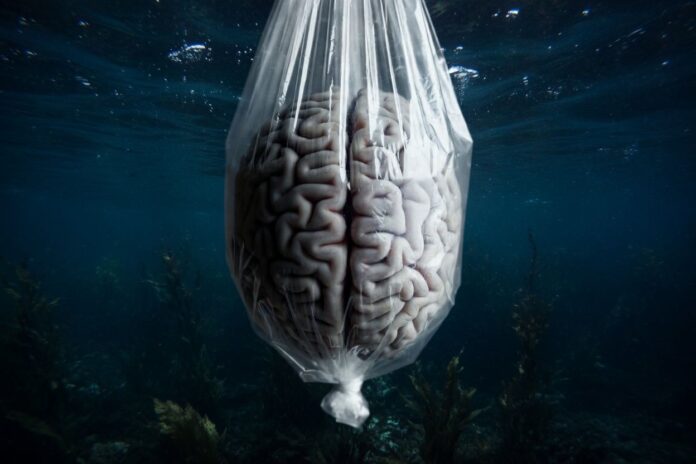
Microplastics: The Tiny Invaders You Didn’t Invite But Already Host
Breaking News: You Are Now 0.0001% Tupperware
There was a time when humans worried about cholesterol, sugar, and perhaps the occasional existential crisis. Those were simpler days.
Today, science has delivered a new dietary category: plastic. Not the visible, chewable kind (though give capitalism time), but microscopic fragments—microplastics—that have quietly infiltrated the human body like uninvited guests who refuse to leave and may or may not rearrange your internal organs.
Defined as particles smaller than 5 millimeters, microplastics are now found practically everywhere: oceans, air, food, drinking water—and, inconveniently, us. (See source: National Geographic)
Learn more about plastic pollution globally: https://www.unep.org/plastic-pollution
You didn’t RSVP. They came anyway.
The Buffet You Never Knew You Were Eating
Microplastics enter the human body through three main routes: ingestion, inhalation, and the general audacity of modern life.
They are in seafood, bottled water, salt, and even the air floating around your living room like invisible confetti from a very slow apocalypse.
Global plastic production has surged into the hundreds of millions of tons annually, ensuring a steady supply of particles that degrade into ever-smaller fragments capable of traveling through ecosystems—and eventually into you. (National Geographic)
Related: How plastic enters the food chain[Text Wrapping Break]https://www.fao.org/in-action/plastic-waste/en/
The phrase “you are what you eat” has never felt so… polymer-based.
Blood, Sweat, and Polymers
In what can only be described as a triumph of scientific curiosity (and perhaps mild horror), researchers have detected microplastics in human blood.
Studies show that various plastic polymers—such as polyethylene and polystyrene—can circulate within the bloodstream, suggesting that these particles can travel throughout the body. (Environment International)
Read the study abstract: https://pubmed.ncbi.nlm.nih.gov/38761430/
Another study has gone further, exploring possible links between microplastics and changes in blood function, including coagulation processes. (Scientific Reports)
Full paper: https://www.nature.com/articles/s41598-024-81931-9
In simpler terms: the stuff your grocery bags are made of may now be on a guided tour of your circulatory system.
No ticket required.
Your Brain on Plastic
If the bloodstream wasn’t unsettling enough, research suggests that microplastics may also accumulate in the brain.
Some studies have found higher concentrations of these particles in brain tissue compared to other organs, raising questions about how they cross the blood-brain barrier—a structure previously assumed to be selective about its guests. (National Geographic)
Deep dive: https://www.nationalgeographic.com/science/article/microplastic-human-brain-health
Reports have described levels so notable that scientists felt compelled to measure them carefully, then quietly reconsider their career choices.
The implications remain unclear, but potential links to neurological conditions are being investigated. (Washington Post)
More insights: https://www.washingtonpost.com/climate-environment/2026/01/04/microplastics-science-discoveries/
Which is to say: your thoughts may still be your own, but they now have company.
The Body’s New Roommates
Microplastics have been detected in multiple human tissues, including organs involved in reproduction, metabolism, and immunity.
Their presence raises concerns not only because they exist, but because they can carry additional passengers: chemicals, heavy metals, and pollutants known to disrupt hormones and biological processes. (Frontiers in Public Health)
Explore health pathways: https://www.frontiersin.org/articles/10.3389/fpubh.2025.1567200/full
Think of microplastics less as particles and more as tiny delivery vehicles—Uber drivers for toxins, except they never log off the app.
Breaking News: You Are Now 0.0001% Tupperware
Health Effects — Or, “We’d Like to Know Too”
Here’s where the story becomes less dramatic and more unsettling: scientists are still figuring out what all this means.
Research suggests possible impacts on inflammation, gut health, and cellular function, with laboratory studies showing that microplastics can cause tissue damage and oxidative stress. (Frontiers in Public Health)
There are also emerging associations with conditions such as cardiovascular disease and neurological disorders, though causation remains unproven. (Washington Post)
Related research overview: https://www.who.int/news-room/fact-sheets/detail/microplastics-in-drinking-water
In other words, we have reached the scientific equivalent of:[Text Wrapping Break]“We are concerned, but not yet panicking. Give it time.”
The Scientific Plot Twist
Just as the narrative was leaning toward dystopian certainty, a plot twist emerged.
Some scientists have begun questioning the reliability of certain studies, suggesting that contamination and measurement errors may have exaggerated the extent of microplastics in the human body. (The Guardian)
Read the debate: https://www.theguardian.com/environment/2026/jan/13/microplastics-human-body-doubt
In several cases, detection methods may have mistaken biological materials for plastic, leading to inflated results.
So while microplastics are undeniably present in the environment—and likely in humans—the exact quantity and impact remain under debate.
Science, it turns out, is still buffering.
Exposure Is Not Optional
Whether or not the most dramatic findings hold up, one fact remains stubbornly intact: exposure to microplastics is nearly unavoidable.
They are in the air we breathe, the water we drink, and the products we use daily.
Airborne microplastics explained: https://www.nature.com/articles/s41561-020-0637-5
Even efforts to avoid plastic—switching to glass containers, reducing packaging—offer only partial protection in a world where synthetic materials have become structurally embedded in modern life.
Avoiding microplastics entirely would require leaving civilization.
Even then, check the soil.
Babies, Before They Even Begin
Perhaps the most unsettling development is the possibility that exposure begins before birth.
Emerging research suggests that microplastics may affect fetal development, with associations observed between exposure and lower birth weight in large-scale population analyses. (Environmental Research)
Preprint study: https://arxiv.org/abs/2410.17391
Which means the human lifecycle may now include a previously undocumented stage: prenatal polymer introduction.
Congratulations—it’s a boy. And possibly a trace amount of polyethylene.
The Economy of Convenience
How did we get here?
The answer is neither mysterious nor particularly flattering.
Plastic is cheap, durable, and endlessly versatile. It revolutionized industries, improved access to goods, and made modern convenience possible.
Global plastics report: https://www.oecd.org/environment/plastics/
It also created a waste problem so persistent that it has begun to circulate through the very bodies that depend on it.
This is not irony. It is efficiency.
What Can Be Done?
Experts generally recommend practical, modest steps:
- Reducing single-use plastics
- Avoiding heating food in plastic containers
- Using alternatives like glass or stainless steel
- Improving waste management systems
Practical guide: https://www.epa.gov/plastics
These measures may reduce exposure, though they cannot eliminate it entirely.
Because microplastics are no longer a contamination problem.
They are an ecosystem.
Final Verdict: We Built This
Microplastics are not an external threat. They are a byproduct of human innovation—tiny, durable reminders of a material we embraced without fully considering its afterlife.
The science is still evolving. The risks are still being assessed. The debates are ongoing.
But one conclusion is difficult to avoid:
We are living in a world where the boundary between environment and body is becoming increasingly porous—sometimes literally.
And somewhere, in a lab, a scientist is staring at a microscope slide and realizing that the line between biology and manufacturing is thinner than anyone expected.
Not broken.
Just… flexible.
By Sayuri
FAQ
What are microplastics?[Text Wrapping Break]Microplastics are tiny plastic particles smaller than 5 millimeters, formed from the breakdown of larger plastic items or manufactured at small sizes.
Are microplastics found in the human body?[Text Wrapping Break]Yes, studies have detected microplastics in human blood, organs, and possibly the brain, though research is ongoing.
Do microplastics harm human health?[Text Wrapping Break]Potential health effects include inflammation, cellular damage, and possible links to disease, but definitive conclusions are still being studied.
How do microplastics enter the body?[Text Wrapping Break]They enter through food, water, air, and everyday products.
Can you avoid microplastics?[Text Wrapping Break]Complete avoidance is currently impossible, but reducing plastic use and exposure can help lower intake.
References
Ferrari, O. (2025). Alarming levels of microplastics found in human brains. National Geographic.[Text Wrapping Break]https://www.nationalgeographic.com/science/article/microplastic-human-brain-health
Lee, D.-W., Jung, J., Park, S.-A., et al. (2024). Microplastic particles in human blood and their association with coagulation markers. Scientific Reports, 14, 30419.[Text Wrapping Break]https://www.nature.com/articles/s41598-024-81931-9
Leonard, S. V. L., Liddle, C. R. L., Atherall, C. A., et al. (2024). Microplastics in human blood: Polymer types, concentrations and characterisation. Environment International.[Text Wrapping Break]https://pubmed.ncbi.nlm.nih.gov/38761430/
Zhang, X., Yu, C., Wang, P., & Yang, C. (2025). Microplastics and human health: Toxicological pathways and implications. Frontiers in Public Health, 13.[Text Wrapping Break]https://www.frontiersin.org/articles/10.3389/fpubh.2025.1567200/full
Li, Y., Ling, W., Yang, J., & Xing, Y. (2025). Risk assessment of microplastics in humans. Polymers, 17(12), 1699.[Text Wrapping Break]https://www.mdpi.com/2073-4360/17/12/1699
Du, X., Zhang, S., & Zou, E. (2024). Marine microplastics and infant health. Environmental Research (preprint).[Text Wrapping Break]https://arxiv.org/abs/2410.17391
The Guardian. (2026). Doubt cast on discovery of microplastics throughout human body.[Text Wrapping Break]https://www.theguardian.com/environment/2026/jan/13/microplastics-human-body-doubt
The Washington Post. (2026). What we learned about microplastics in 2025.[Text Wrapping Break]https://www.washingtonpost.com/climate-environment/2026/01/04/microplastics-science-discoveries/