Interstellar 3I/ATLAS get very active Space photo of the week
Discovered in July 2025, this mysterious traveler recently made its closest approach to the Sun (perihelion) around October 30, 2025. This intense heating is causing its icy surface to sublimate rapidly, unleashing massive jets of gas and dust. This surge of activity makes it a prime target for space observatories, as scientists hope to uncover the secrets of its potentially ancient, alien origin.
This is a once-in-a-lifetime chance to study a true relic from another star system, as 3I/ATLAS is moving on a hyperbolic trajectory and will soon exit our solar system, never to return.
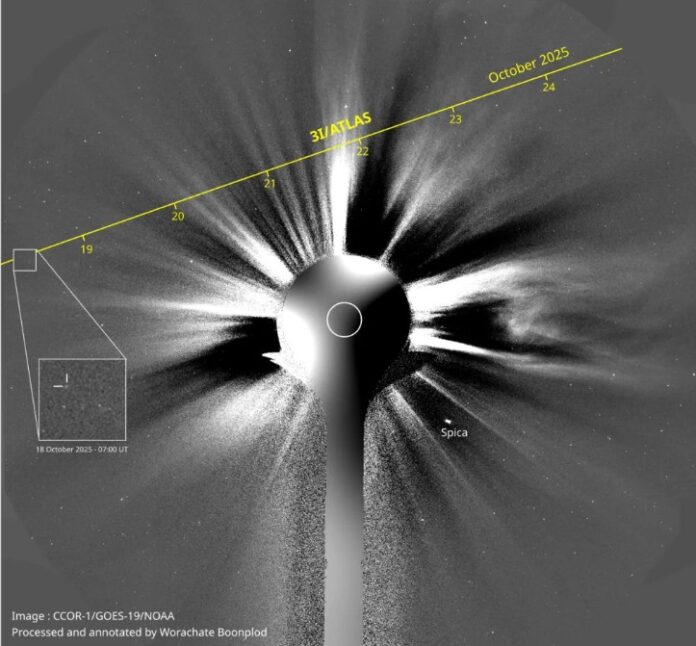
The interstellar comet 3I/ATLAS is barreling toward its closest point to the sun as perihelion looms on Oct. 29. How different will it look when it reappears on the other side?
Even as a brilliant, naked-eye comet slices through Earth’s sky (cheers, Comet Lemmon!), the most famous object in the solar system right now is hidden on the far side of the sun: the interstellar comet 3I/ATLAS.
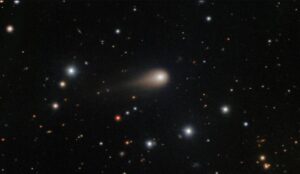 An edited version of the image ‘freezes’ the background stars in place as 3I/ATLAS charges through the center of the frame.(Image credit: International Gemini Observatory/NOIRLab/NSF/AURA/Shadow the ScientistImage Processing: J. Miller & M. Rodriguez (International Gemini Observatory/NSF NOIRLab), T.A. Rector (University of Alaska Anchorage/NSF NOIRLab), M. Zamani (NSF NOIRLab))
We’ll miss our interstellar friend, but at least we’ll always have the photos. The image above, captured Aug. 27 by the National Science Foundation-operated Gemini South telescope in Chile, may be the clearest image we have so far. As 3I/ATLAS zooms closer to the sun, radiation from our star heats the ice on the comet’s body (its nucleus), causing geysers of gas and dust to shoot outward and form a glowing plume (a coma) around it. Radiation pressure from our star’s unrelenting solar wind pushes this material into a long, prominent tail angled away from the sun.
As 3I/ATLAS reaches perihelion this week coming within 1.4 astronomical units, or 130 million miles (210 million kilometers) of the sun, according to NASA it may start releasing gas in overdrive. When the comet becomes visible to telescopes again in early November, it may look both bigger and brighter than how it appeared two months ago. Instruments on the ground, in orbit and even on their way to Jupiter will snap to attention, making 3I/ATLAS an even bigger space celebrity as it zooms away from our solar system forever.
Studying the interstellar comet with the full range of humankind’s astronomical instruments could yield untold secrets about the outer reaches of our galaxy and its mysterious history. Until then, all we can do is wait, feel the warm sunlight on our faces, and know that a trove of cosmic information lurks just on the other side of our star.
For more sublime space images, check out our Space Photo of the Week archives.
Source Live Science
By: Brandon Specktor is the space/physics editor at Live Science. His writing has appeared in The Washington Post, Reader’s Digest, CBS.com, the Richard Dawkins Foundation website and other outlets.